
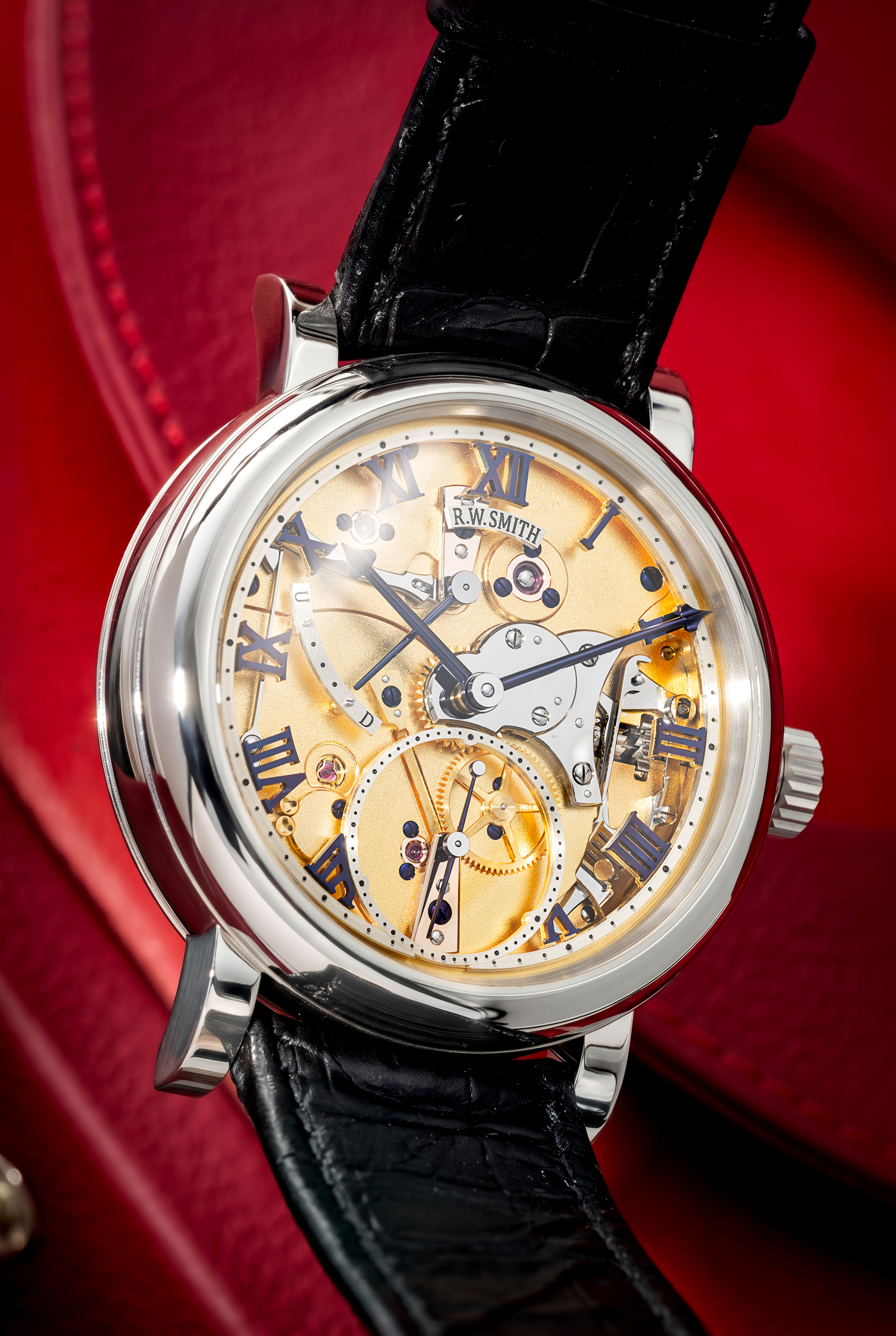
An exploration of the Roger W. Smith Series 5 Open Dial in platinum, where the legacy of George Daniels, traditional English watchmaking and the individuality of hand craftsmanship converge.
There are watches that are rare because their production is deliberately limited.
And then there are watches that are rare because the people capable of making them are few.
Roger W. Smith belongs firmly to the latter tradition.
Working from a small workshop on the Isle of Man, Smith has devoted his career to preserving an approach to watchmaking that has largely disappeared from the modern industry. One in which the creation of a watch begins not with an industrial production line, but with the individual craftsman.
His watches are not simply assembled from components manufactured elsewhere. Their movements, cases, dials and hands are created through an unusually comprehensive process of traditional watchmaking, with much of the work undertaken by hand.
It is a philosophy inherited from one of the twentieth century’s most important watchmakers, Dr George Daniels.
And nowhere is this philosophy expressed more openly than in the Series 5.
Housed within a 40mm platinum case, the Series 5 Open Dial reveals the intricate architecture normally concealed beneath a conventional watch dial. Its golden surfaces, sculpted steel components and hand-engraved details form a remarkably elaborate composition.
Yet this is not simply a watch designed to display its movement.
It is an expression of a much older idea.
That the making of a watch, in its entirety, can itself be an art.
The Watchmaker Who Refused to Give Up
The story of Roger W. Smith is inseparable from that of George Daniels.
By the late twentieth century, Daniels had established himself as one of the most important figures in independent watchmaking. Working largely alone, he demonstrated that a single watchmaker could conceive, construct and finish a complete mechanical watch to an extraordinary standard.
His approach challenged the increasingly industrial nature of Swiss watch production.
For the young Roger Smith, discovering Daniels’ work would prove decisive.
Having trained in horology, Smith became determined to follow the same path. He sought Daniels’ guidance, only to discover that admiration alone would not be enough.
Daniels challenged him to make a watch.
Smith’s first attempt failed to meet the master’s expectations.
Rather than abandoning the ambition, he returned to his workbench and began again.
His second attempt, a painstakingly constructed pocket watch incorporating a tourbillon and perpetual calendar, eventually earned Daniels’ approval.
The process had taken years.
It also established the foundations of a relationship that would shape the future of British independent watchmaking.
Smith subsequently worked alongside Daniels on the Isle of Man, learning not merely how to construct complicated mechanisms, but how to approach watchmaking as a complete discipline.
The distinction is important.
Daniels believed that a watchmaker should understand and, wherever possible, master every aspect of the watch’s creation.
From the movement’s architecture to its finishing, from the dial to the case, each element belonged to a coherent whole.
It was an uncompromising philosophy.
And one that Roger Smith would eventually carry forward under his own name.
The Daniels Method
In modern watchmaking, the word handmade is often used rather loosely.
A movement may contain hand-finished components, while the majority of its parts are manufactured using industrial processes. A case may be polished by hand, even though its underlying construction is entirely machine-produced.
The approach associated with George Daniels was considerably more demanding.
Known as the Daniels Method, it sought to return watchmaking to a form of individual craftsmanship in which the watchmaker assumes responsibility for almost every stage of production.
The method does not reject machinery altogether.
Rather, it places machinery in the service of the craftsman, allowing components to be made and finished according to the requirements of the watch rather than the limitations of mass production.
Roger Smith has continued to develop this philosophy.
At his workshop on the Isle of Man, traditional tools and techniques coexist with carefully selected modern equipment. Components are produced in small quantities, with extensive handwork involved in their manufacture, adjustment and finishing.
The result is a form of production that cannot easily be accelerated.
Increasing output is not simply a matter of adding another production line.
It requires training craftspeople capable of working to an exceptionally demanding standard, while preserving the consistency and character of the finished watches.
This helps explain why Roger W. Smith occupies such a distinctive position within contemporary independent watchmaking.
His rarity is not merely a commercial proposition.
It is a consequence of how the watches are made.
The Series 5: Revealing What Was Never Meant to Be Seen
The origins of the Series 5 can be traced to an idea Roger Smith began exploring in 2008.
He had long been fascinated by the intricate mechanical landscape hidden beneath a watch dial.
The bridges, wheels, levers and carefully finished components that a watchmaker encounters during assembly are normally invisible to the owner.
Smith wanted to change that.
The first Open Dial watch was completed in 2010, developing the architecture of the Series 2 into something considerably more revealing.
Rather than simply removing the dial, Smith reconsidered how the movement itself could become the visual foundation of the watch.
The concept evolved over several years, eventually leading to the introduction of the Series 5 in 2019.
Its significance lies in the distinction between exposing a movement and designing one to be seen.
Conventional skeletonisation often involves removing material from plates and bridges to reveal the mechanisms beneath.
The Series 5 takes a different approach.
Its movement retains the solidity and architectural depth characteristic of traditional English watchmaking. The open dial allows the observer to appreciate the relationships between components without sacrificing the sense of mechanical substance.
There is a remarkable three-dimensional quality to the arrangement.
Raised bridges, carefully bevelled edges and contrasting surface finishes create a landscape of different heights and textures.
The effect changes with the light.
What initially appears to be a complex golden dial gradually reveals itself as a carefully considered mechanical composition.
A Different Tradition of Finishing
Much of contemporary haute horlogerie draws its visual language from the traditions of Geneva.
Striped bridges, polished bevels and elaborate decoration have become familiar expressions of Swiss movement finishing.
English watchmaking developed a different aesthetic.
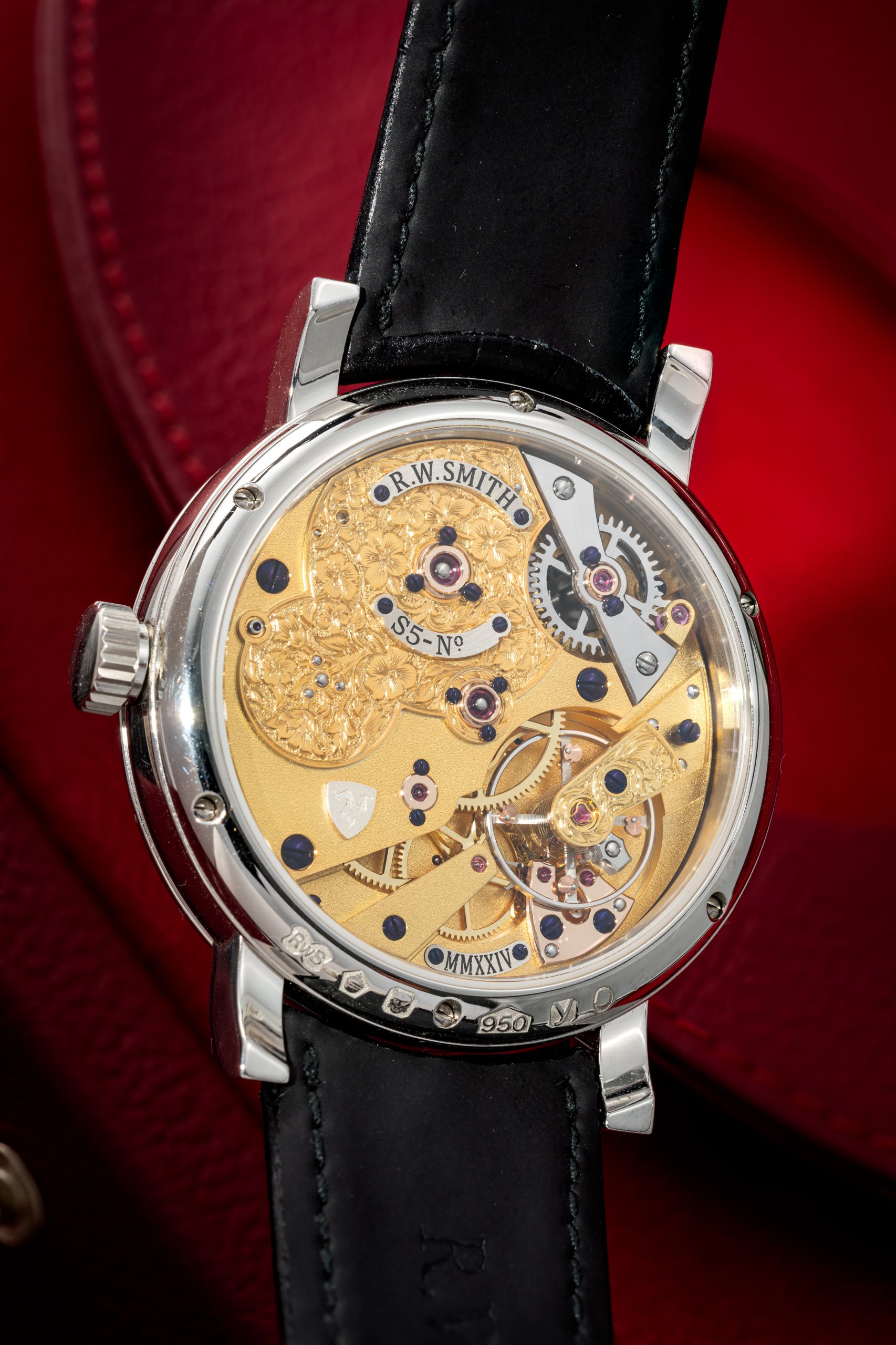
Historically, English movements often favoured broad plates, restrained engraving and finely frosted surfaces. Rather than relying on extensive decorative striping, the emphasis was placed on the quality of the metalwork and the subtle contrast between finishes.
The Series 5 celebrates this tradition.
Its exposed surfaces are finished with a fine frosting, producing a soft, almost granular texture that diffuses the light.
Against these matte golden surfaces, the polished steel components appear particularly vivid.
Bevelled edges introduce further contrast, while heat-coloured screws provide small accents of blue and purple.
Gold chatons surround selected jewels, recalling the construction methods of traditional English pocket watches.
The effect is remarkably rich, yet never feels arbitrary.
Each finish serves to distinguish one component from another, revealing the structure of the movement while celebrating the work involved in its creation.
The Series 5 is therefore more than an exercise in decoration.
It is a study in how traditional finishing can give mechanical architecture its own visual identity.
The Co-Axial Escapement: A Legacy Continued
Perhaps the most important mechanical connection between Roger Smith and George Daniels lies in the escapement.
For much of the history of mechanical watchmaking, the Swiss lever escapement has dominated wristwatch production.
Its success is understandable. It is robust, relatively straightforward to manufacture at scale and capable of excellent performance.
Yet its operation involves sliding friction between components, creating a dependence on lubrication.
George Daniels believed that this fundamental limitation could be improved.
His solution was the Co-Axial escapement.
By separating the locking and impulse functions and reducing sliding friction, Daniels developed a mechanism intended to improve the long-term performance of mechanical watches.
It became one of his defining achievements.
Roger Smith subsequently developed his own interpretation of the design.
His single-wheel evolution of the Daniels Co-Axial escapement simplifies aspects of the original construction while preserving its underlying principles.
The Series 5 incorporates this development, together with Smith’s free-sprung Quadrajust balance.
Operating at 18,000 vibrations per hour, the movement follows a relatively traditional rhythm, consistent with Smith’s emphasis on mechanical efficiency and longevity.
For collectors, the importance of this mechanism extends beyond its technical characteristics.
It represents a direct continuation of Daniels’ work.
Not simply the preservation of an invention, but its ongoing refinement by the watchmaker who inherited his philosophy.
A Platinum Series 5 with a Distinctive Character
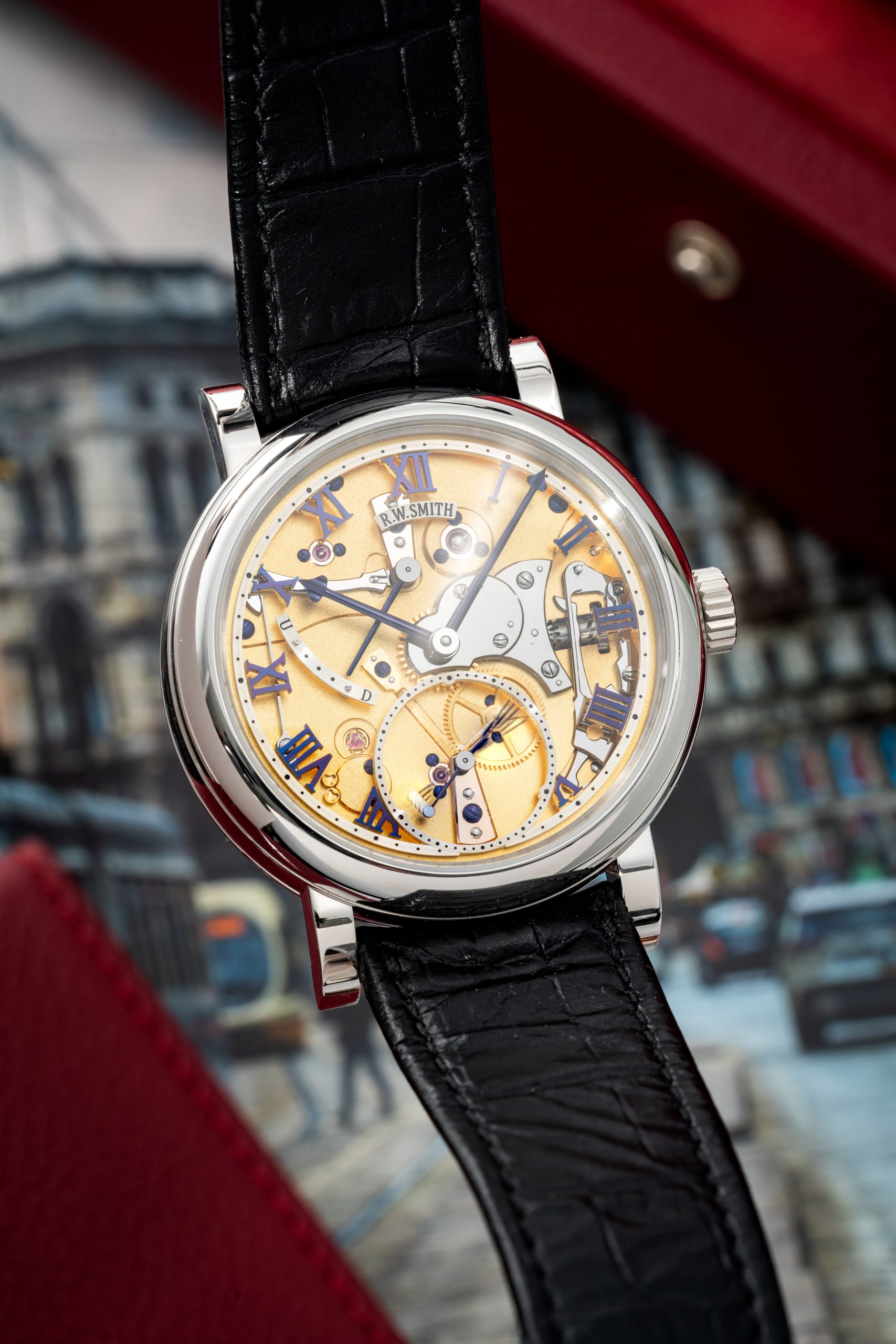
The particular Series 5 Open Dial featured here is housed in a 40mm platinum case.
Its restrained exterior provides an interesting contrast to the elaborate mechanical landscape beneath the sapphire crystal.
Platinum is a notably dense precious metal, lending the watch a substantial physical presence despite its relatively classical proportions.
Yet the case itself remains understated.
Its polished surfaces, gently curved profile and traditional lugs allow the exposed movement to remain the centre of attention.
What makes this particular example especially compelling is the character of its engraving.
Floral motifs have long formed part of the English decorative tradition, appearing on movement bridges and balance cocks as an expression of individual craftsmanship.
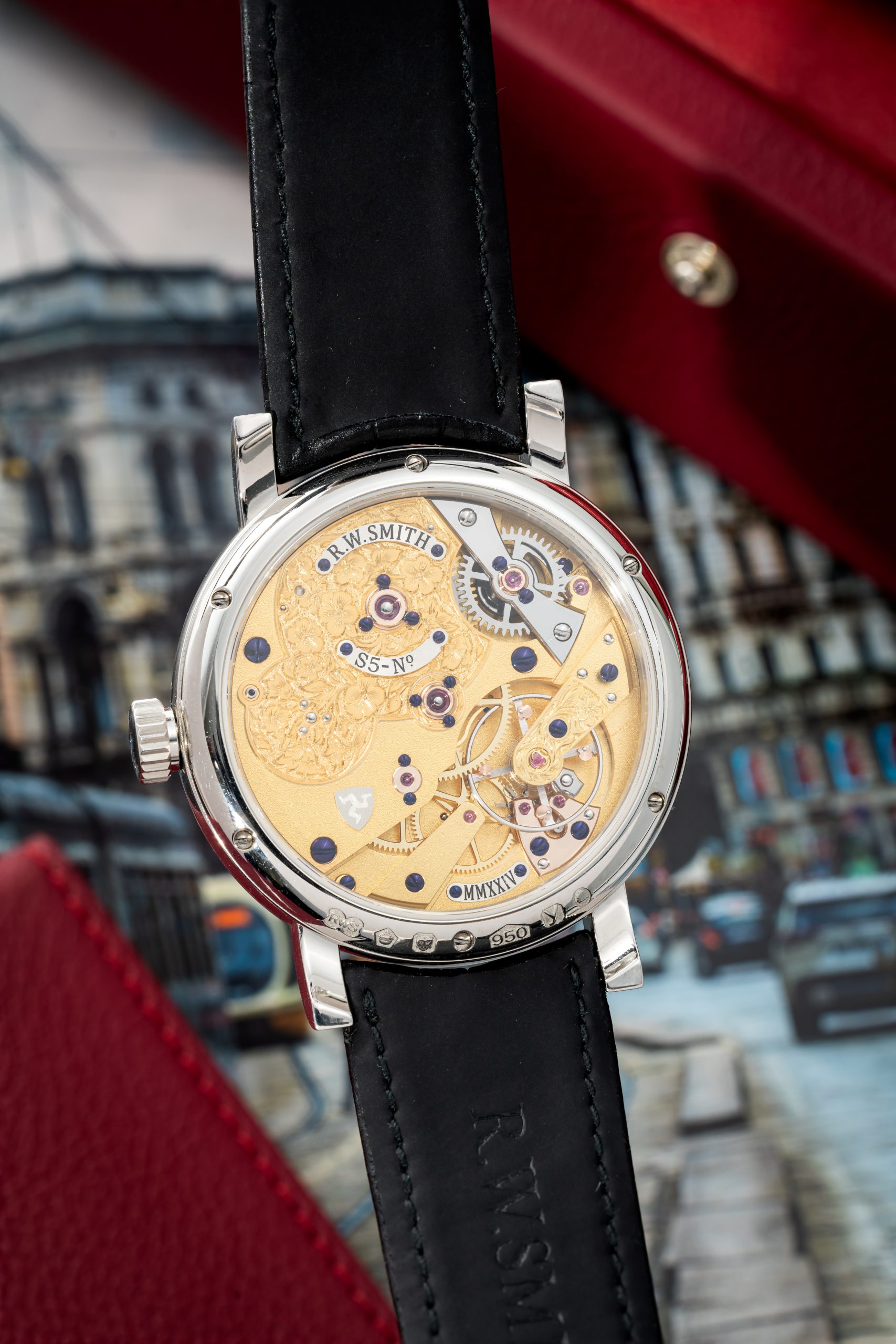
This example features distinctive cherry-blossom-inspired engraving, lending the movement a character that is both delicate and unusually personal.
It is an important distinction.
Not every platinum Series 5 carries the same engraving, and the decorative treatment of individual watches can vary.
Here, the floral work introduces a softer, almost poetic element to the otherwise technical architecture of the movement.
The contrast is particularly striking.
Broad golden plates and precisely finished steel components provide a sense of mechanical strength, while the engraved blossoms introduce a delicacy that could only be achieved through patient, controlled craftsmanship.
It is this relationship between engineering and artistry that gives the watch much of its individuality.
A Watch That Rewards a Closer Look
One of the most interesting qualities of the Series 5 is how differently it reveals itself depending on the distance from which it is viewed.
From across a room, the watch appears almost like a piece of intricate gold jewellery contained within a platinum frame.
Move closer, and the apparent decoration begins to resolve into individual mechanical components.
The wheels, levers and bridges become distinguishable. The subtle differences between polished and frosted surfaces emerge. The engraving reveals the minute irregularities that distinguish handwork from industrial repetition.
Turn the watch over, and the experience continues.
Through the sapphire-crystal caseback, the movement presents another expression of traditional English watchmaking.
The broad plates, engraved bridges and carefully arranged components offer a different perspective on the same mechanical philosophy.
This duality is central to the appeal of the Open Dial.
Unlike a conventional watch, where the dial conceals the mechanism, the Series 5 invites the owner to engage directly with the process of timekeeping.
The movement is no longer simply something that operates unseen.
It becomes part of the everyday experience of wearing the watch.
Why the Series 5 Matters
In recent years, independent watchmaking has attracted increasing attention from collectors.
Yet the term encompasses a remarkably diverse group of watchmakers, each with their own philosophy, aesthetic and approach to production.
Some have built their reputations around unusual complications. Others have explored unconventional materials, contemporary design or radical mechanical architecture.
Roger W. Smith occupies a rather different position.
His work is rooted in the preservation and continued development of a specific tradition.
The Series 5 is particularly significant because it makes that tradition visible.
Its open architecture allows the collector to appreciate not only the mechanical design, but also the finishing techniques and individual craftsmanship that define the watch.
There is no attempt to conceal the labour involved.
On the contrary, the watch celebrates it.
This is perhaps what distinguishes the Series 5 from many other openworked watches.
Its purpose is not simply to reveal complexity.
It is to reveal craftsmanship.
And in doing so, it offers a rare perspective on the methods, values and ambitions of one of contemporary watchmaking’s most respected independent ateliers.
The Value of Time
There is an irony in the creation of a Roger W. Smith watch.
An object designed to measure time requires an extraordinary amount of it to produce.
Hours are spent shaping components that may never be seen. Days are devoted to finishing surfaces whose beauty can only be appreciated under magnification. Years of experience are distilled into adjustments measured in fractions of a millimetre.
Much of this work will remain invisible to anyone who encounters the finished watch.
Yet it is precisely this unseen labour that gives the object its significance.
The Series 5 offers a rare opportunity to look beyond the finished exterior and appreciate the craftsmanship normally hidden beneath it.
Its exposed movement reveals the patience of traditional English watchmaking, while its Co-Axial escapement carries forward the technical legacy of George Daniels.
The distinctive engraving of this platinum example adds another dimension, reminding us that even within a recognisable series, the work of the individual craftsman can create something deeply personal.
For Roger Smith, the challenge has never been simply to make a watch that tells the time.
It has been to make a watch worthy of the time invested in its creation.
And perhaps that is the enduring appeal of the Series 5.
In a world increasingly concerned with producing more, faster, it represents the quiet conviction that some things are worth making slowly.
Discover the Roger W. Smith Series 5 Open Dial at J.PENDULUM
J.PENDULUM specialises in exceptional independent watchmaking, rare grand complications and historically significant timepieces from the world’s most respected manufactures.
The Roger W. Smith Series 5 Open Dial in platinum, featuring its distinctive hand-engraved movement and single-wheel Co-Axial escapement, is presented as part of our collection in Singapore.
Collectors are invited to explore this exceptional example of contemporary British watchmaking and enquire about our collection of rare independent timepieces.
J.PENDULUM
Far East Plaza, 14 Scotts Road, Singapore 228213
Parkway Parade, 80 Marine Parade Road, Singapore 449269
Explore the Roger W. Smith Series 5 Open Dial in Platinum