
The story of the Patek Philippe Ref. 5216R, an extraordinary grand complication that brings together a minute repeater, tourbillon and retrograde perpetual calendar within a remarkably restrained rose-gold case.
There is a particular kind of confidence in a watch that has nothing to prove.
At first glance, the Patek Philippe Ref. 5216R appears almost conventional. Its rose-gold case measures a modest 39.5mm, while the silvery dial, applied hour markers and elegantly arranged calendar suggest the familiar language of traditional Genevan watchmaking.
Nothing about its appearance immediately reveals the extraordinary complexity concealed within.
Beneath the dial lies a one-minute tourbillon, a perpetual calendar capable of accounting for the irregularities of the Gregorian calendar, and a minute repeater that can announce the time through a sequence of carefully tuned chimes.
Three of watchmaking’s most demanding complications, brought together within a single wristwatch.
Yet what makes the 5216R so compelling is not simply the mechanical achievement.
It is the remarkable restraint with which that achievement is presented.
To understand the significance of this watch, we must first return to one of the most important grand complications in Patek Philippe’s modern history.

The Legacy of the Reference 5016
In 1993, Patek Philippe introduced the Ref. 5016, a watch that would occupy a particularly important position within the manufacture’s history.
Combining a minute repeater, tourbillon and retrograde perpetual calendar, it was, at the time of its introduction, the most complicated wristwatch Patek Philippe had ever produced.
The achievement was remarkable not only for the number of complications involved, but also for the proportions in which they were contained.
The Ref. 5016 measured just 37mm and featured an officer-style case with a hinged back, recalling an earlier period of traditional watchmaking.
Its appearance was classical, almost understated.
The complexity was largely invisible.
This philosophy would become central to the identity of the reference and, eventually, its successor.
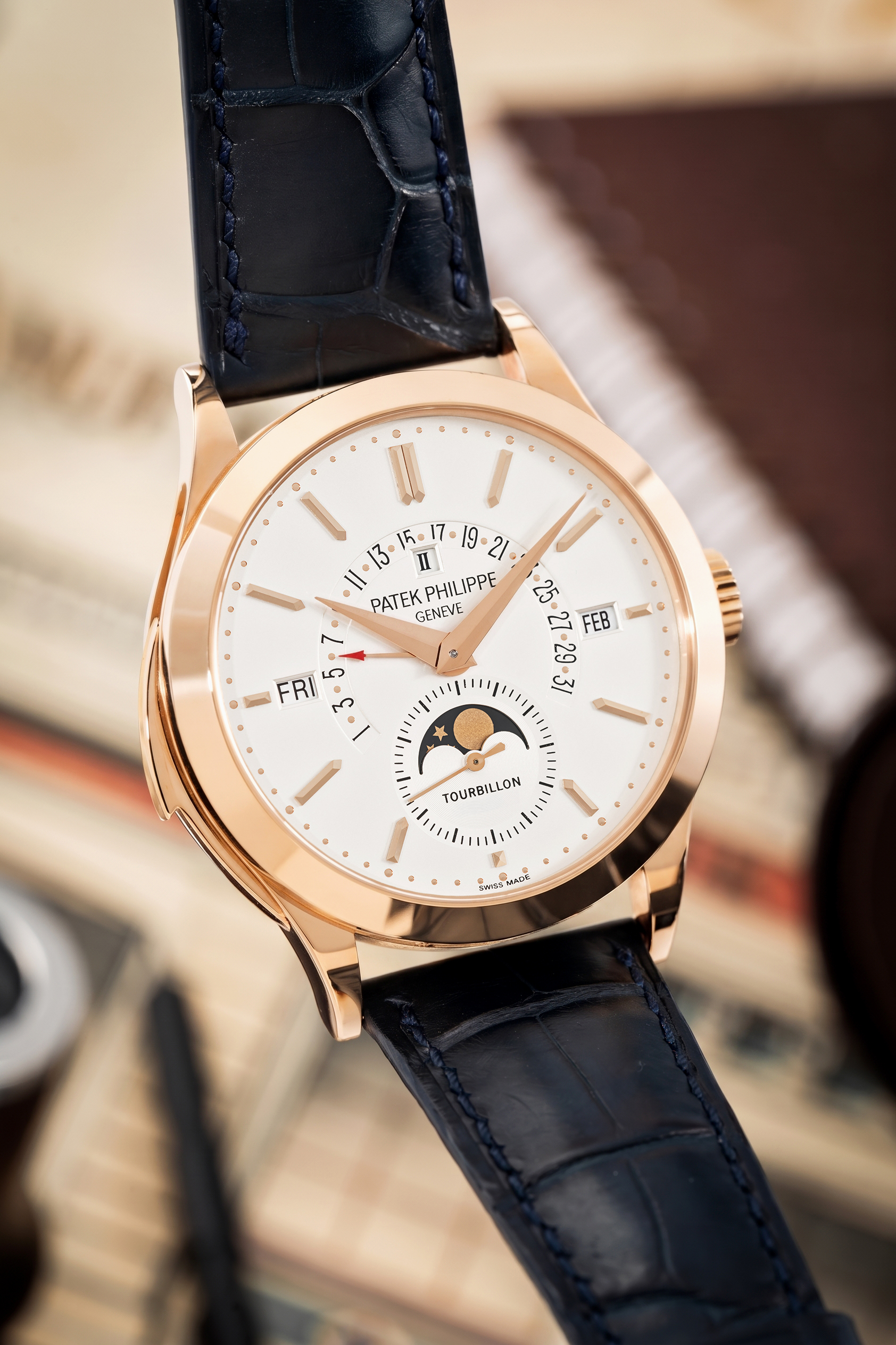
When Patek Philippe introduced the Ref. 5216R in 2011, it did not attempt to reinvent the original concept.
Instead, the manufacture refined it.
The officer-style case gave way to a more contemporary design, while the diameter increased to 39.5mm. The essential arrangement of complications remained, preserving the mechanical philosophy that had made the 5016 so significant.
The result was a watch that felt more contemporary without abandoning its historical foundations.
And in many respects, it represented the continuation of a tradition that had become increasingly uncommon.
One in which mechanical complexity was something to be discovered, rather than immediately displayed.
When Time Becomes Sound
Of all the complications housed within the 5216R, the minute repeater is perhaps the most evocative.
Its origins belong to an era before electric lighting, when determining the time after dark was not always straightforward.
Repeating watches provided an ingenious solution.
Rather than requiring their owners to read the dial, these mechanisms could announce the time through a sequence of audible strikes.
What began as a practical invention would eventually evolve into one of the most sophisticated disciplines in mechanical watchmaking.
The 5216R continues this tradition.
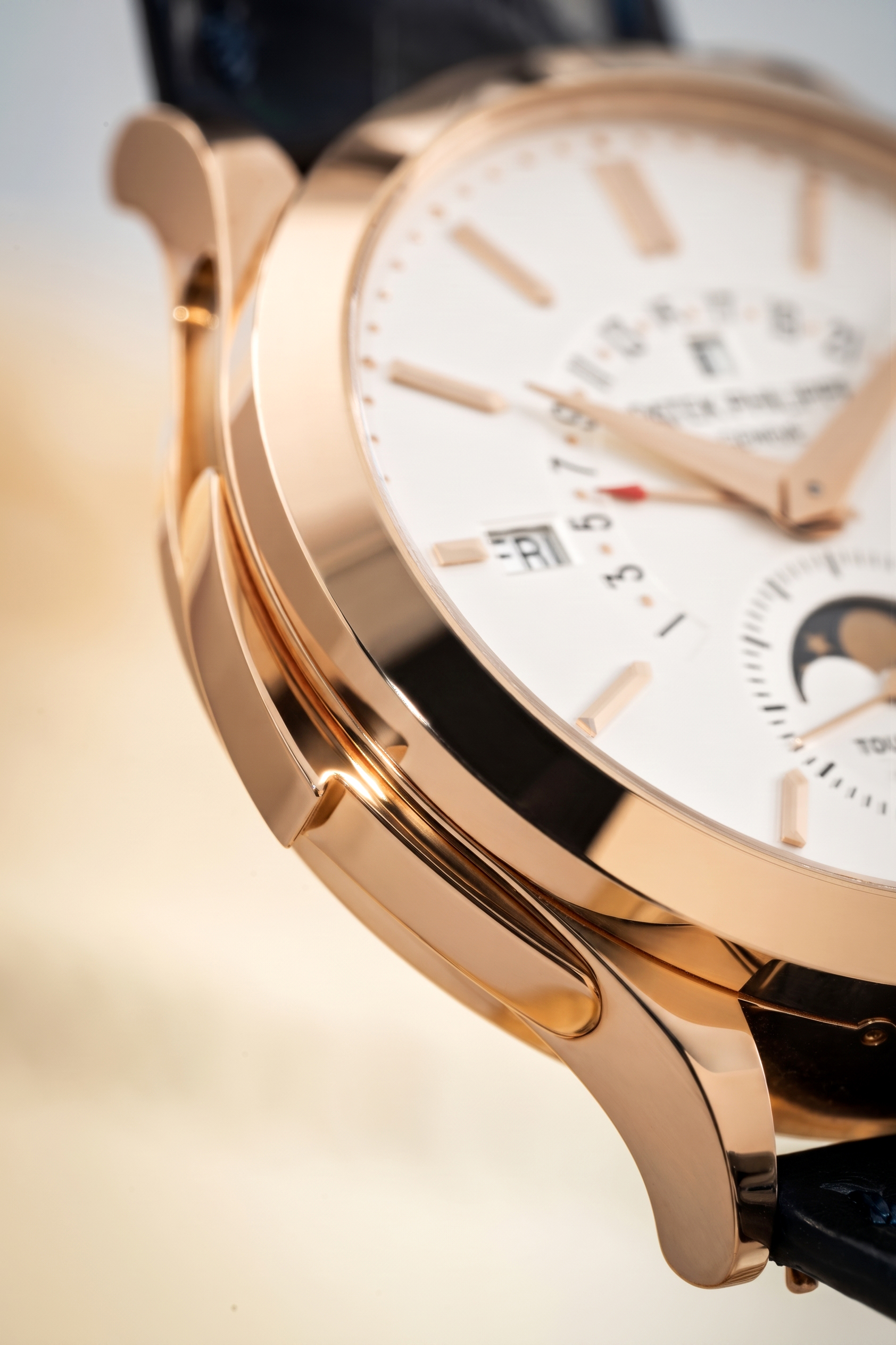
A discreet slide positioned along the left side of the case activates a striking mechanism comprising two hammers and two steel gongs.
The hours are announced through low-pitched strikes, the quarter hours through alternating high and low tones, and the remaining minutes through high-pitched strikes.
At 10:38, for example, the watch sounds ten low strikes, two double strikes and eight high strikes.
The sequence appears deceptively simple.
Yet beneath the dial, an elaborate mechanical system must interpret the position of the hands, determine the appropriate number of strikes and execute them in the correct order.
The hammers must be adjusted with extraordinary precision. The gongs must be carefully tuned, and the rhythm of the strikes must remain consistent.
Even the case itself contributes to the final result.
Its dimensions, construction and material influence the transmission and character of the sound.
For Patek Philippe, the minute repeater is not simply a technical complication. It is an acoustic instrument, one whose quality depends on the relationship between hundreds of individual components.
And unlike a perpetual calendar or chronograph, its achievement cannot be fully appreciated by sight alone.
The experience is fleeting.
A slide is activated. The mechanism comes to life. The watch announces the time.
And then, silence.
The Tourbillon That Refuses to Be Seen
There is something particularly interesting about Patek Philippe’s approach to the tourbillon.
In contemporary watchmaking, the mechanism has become one of the most recognisable symbols of mechanical sophistication.
Many manufactures choose to display it prominently through an opening in the dial, allowing its rotating cage to become the centrepiece of the watch.
Patek Philippe has traditionally preferred a different approach.
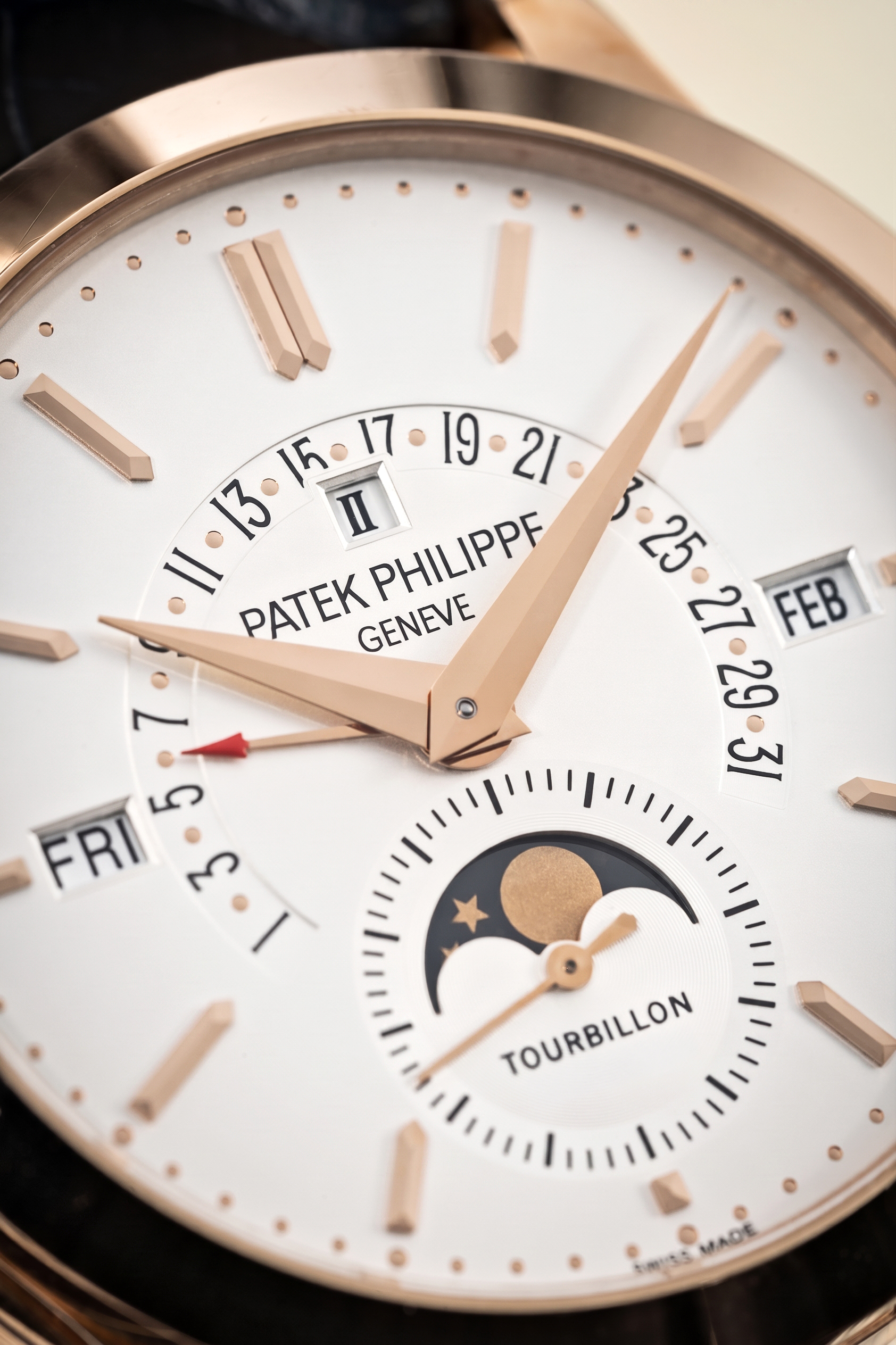
On the 5216R, the tourbillon is concealed beneath the dial.
Its presence is acknowledged only through a discreet inscription.
The mechanism itself is extraordinary.
Comprising 69 individual components and weighing approximately 0.3 grams, the tourbillon cage completes one revolution every minute.
Originally conceived to compensate for positional variations affecting the accuracy of pocket watches, the tourbillon remains one of the most intricate mechanisms in traditional watchmaking.
Its construction demands exceptional precision, particularly in the manufacture and adjustment of the rotating cage.
Patek Philippe’s decision to conceal the mechanism is partly technical. The manufacture has historically cited the potential effects of light on the lubricants used within the tourbillon as a reason for avoiding exposed dial-side constructions.
Yet the result is also aesthetic.
By keeping the tourbillon hidden, the dial retains the quiet elegance of a traditional dress watch.
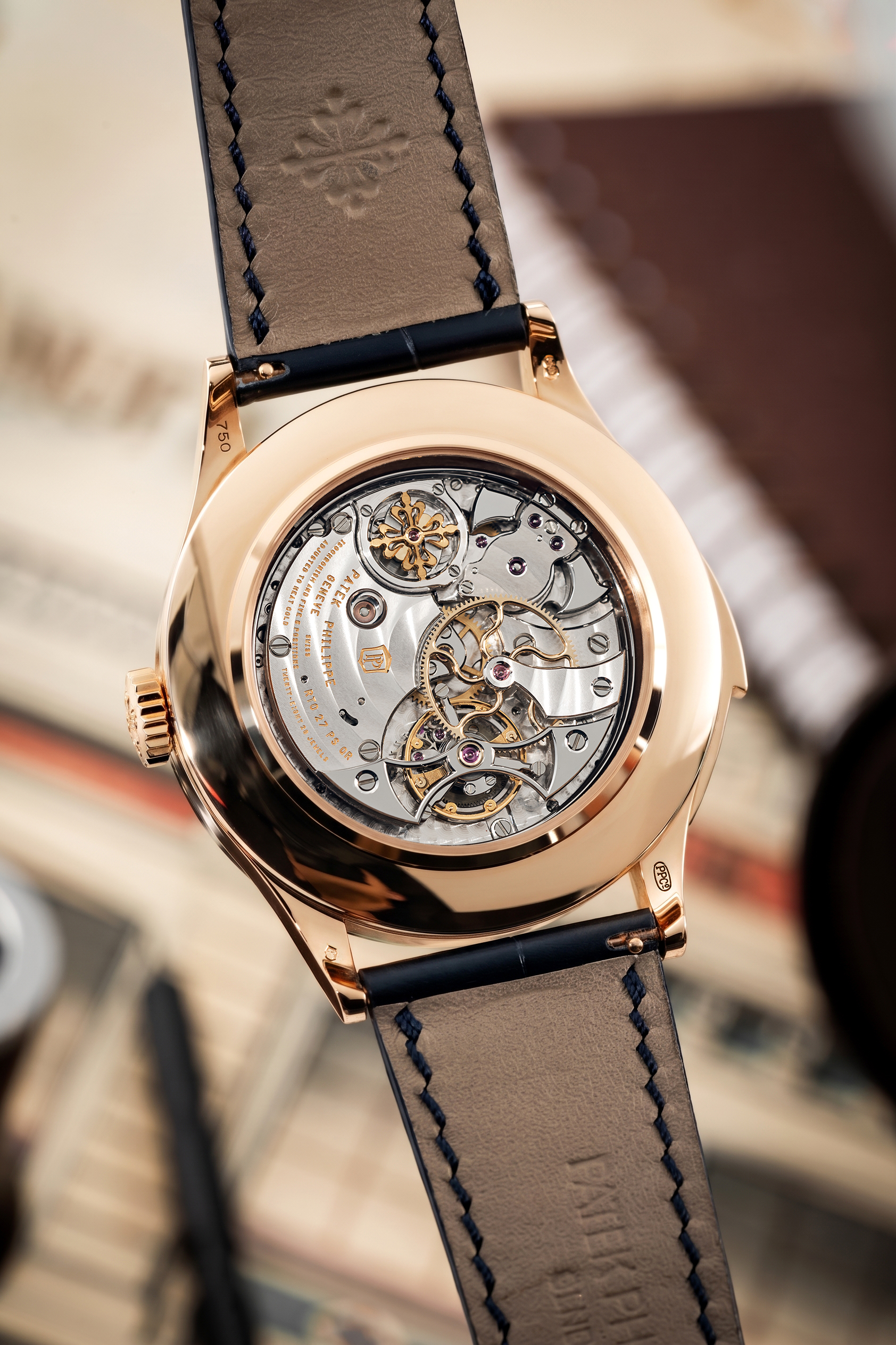
Only when the watch is turned over does its true character begin to emerge.
Through the sapphire-crystal caseback, the intricate architecture of the movement becomes visible, revealing the tourbillon alongside the elaborate arrangement of bridges, wheels and levers.
It is an unusual contrast.
From the front, the watch offers little indication of the mechanical achievement concealed within.
From behind, that achievement becomes impossible to ignore.
A Calendar That Understands Time
The perpetual calendar is among the most intellectually fascinating complications in traditional watchmaking.
Its purpose is deceptively straightforward: to display the correct date while automatically accounting for months of different lengths and the occurrence of leap years.
The challenge lies in translating the irregularities of the Gregorian calendar into a purely mechanical system.
A conventional calendar watch must be corrected at the end of shorter months.
A perpetual calendar, by contrast, incorporates a mechanical programme that recognises the different lengths of the months and the four-year leap-year cycle.
The Ref. 5216R accomplishes this while presenting the information through an unusually elegant dial arrangement.
The day and month appear through apertures, accompanied by a leap-year indication and moon-phase display.
The most distinctive element, however, is the retrograde date.
Rather than completing a continuous revolution, the date hand travels across a broad arc spanning the upper portion of the dial.
As the month progresses, the hand advances towards its final position.
At the end of the month, it returns instantly to the beginning.
It is a brief moment of mechanical theatre.
What makes the arrangement particularly appealing is the contrast between the gradual passage of time and the sudden return of the hand.
For most of the month, the mechanism operates almost imperceptibly.
Then, in an instant, an entire month gives way to the next.
The complication introduces a sense of movement and personality to a dial that might otherwise appear almost conservative.
And yet, despite the amount of information displayed, the overall composition remains remarkably balanced.
There is no sense of visual excess.
Each indication has its place.
506 Components, One Remarkable Movement
At the heart of the 5216R lies the manually wound calibre R TO 27 PS QR LU.
Comprising 506 individual components, the movement brings together the minute repeater, tourbillon, retrograde perpetual calendar and moon-phase indication within a construction measuring just 28mm in diameter and 8.6mm in height.
These dimensions are particularly impressive when one considers the demands of each complication.
The minute repeater requires an elaborate system of racks, snails, levers, hammers and gongs.
The tourbillon introduces a rotating regulating assembly that must operate with exceptional precision.
The perpetual calendar incorporates its own mechanical programme, capable of recognising the changing lengths of the months.
Each mechanism has its own requirements.
Yet all must function together within the limited space of a wristwatch movement.
The finishing is equally significant.
Polished bevels, decorated bridges and meticulously finished steel components reflect the traditions of Genevan haute horlogerie.
Many of these details serve no direct functional purpose. Their importance lies instead in the time, skill and discipline required to execute them.
They are expressions of craftsmanship intended to endure long after the watch has left the workshop.
Through the sapphire-crystal caseback, the movement reveals a level of mechanical density that contrasts sharply with the simplicity of the dial.
The front of the watch is an exercise in restraint.
The reverse is an exhibition of extraordinary complexity.
The Art of Concealing Complexity
Within the world of grand complications, there has always been a temptation to equate mechanical achievement with visual spectacle.
The more complicated a watch becomes, the more elaborate its appearance is often expected to be.
The Ref. 5216R challenges this assumption.
Despite containing three of the most demanding complications in traditional watchmaking, its appearance remains remarkably composed.
There is no exposed tourbillon dominating the dial.
No elaborate skeletonisation revealing the movement beneath.
Even the minute repeater, arguably the most extraordinary complication of all, remains invisible until activated.
The watch communicates its complexity through subtle details rather than obvious displays.
Its retrograde date introduces movement without overwhelming the dial. Its rose-gold case offers warmth without extravagance. Its proportions remain firmly rooted in the traditions of classical watchmaking.
This restraint is not incidental.
It is fundamental to the character of the watch.
For collectors accustomed to increasingly elaborate expressions of mechanical watchmaking, the 5216R offers something rather different.
An appreciation of complexity that does not depend on spectacle.
Beyond Complication
It is tempting to consider the Patek Philippe Ref. 5216R primarily in terms of its mechanical achievements.
After all, few wristwatches combine a minute repeater, tourbillon and retrograde perpetual calendar within such restrained proportions.
Yet the significance of the 5216R extends beyond the number of complications it contains.
It represents the continuation of a philosophy established by the Ref. 5016, one in which extraordinary mechanical ambition is expressed through the familiar language of traditional watchmaking.
Its complications are not arranged to compete for attention.
They coexist.
The perpetual calendar quietly follows the passage of months and years. The tourbillon rotates beneath the dial, unseen by its owner. The minute repeater remains silent until called upon to announce the time.
Each mechanism performs its task without demanding recognition.
And perhaps that is what makes the 5216R so compelling.
In an era when complicated watches increasingly reveal everything at first glance, Patek Philippe created one that continues to reward a closer look.
The Ref. 5216R reminds us that the greatest achievements in watchmaking are not always those that announce themselves most loudly.
Sometimes, they are the ones that have mastered the art of remaining quiet.
Discover the Patek Philippe Ref. 5216R at J.PENDULUM
J.PENDULUM specialises in rare Patek Philippe timepieces, grand complications and historically significant watches from the world’s most respected manufactures.
A Patek Philippe Grand Complications Ref. 5216R in 18k rose gold, featuring a minute repeater, tourbillon and retrograde perpetual calendar, is featured in our collection in Singapore.
Collectors are invited to explore this exceptional timepiece and enquire about a private viewing at our boutique.
J.PENDULUM
14 Scotts Road, Far East Plaza
Singapore 228213
View the Patek Philippe Grand Complications Ref. 5216R