
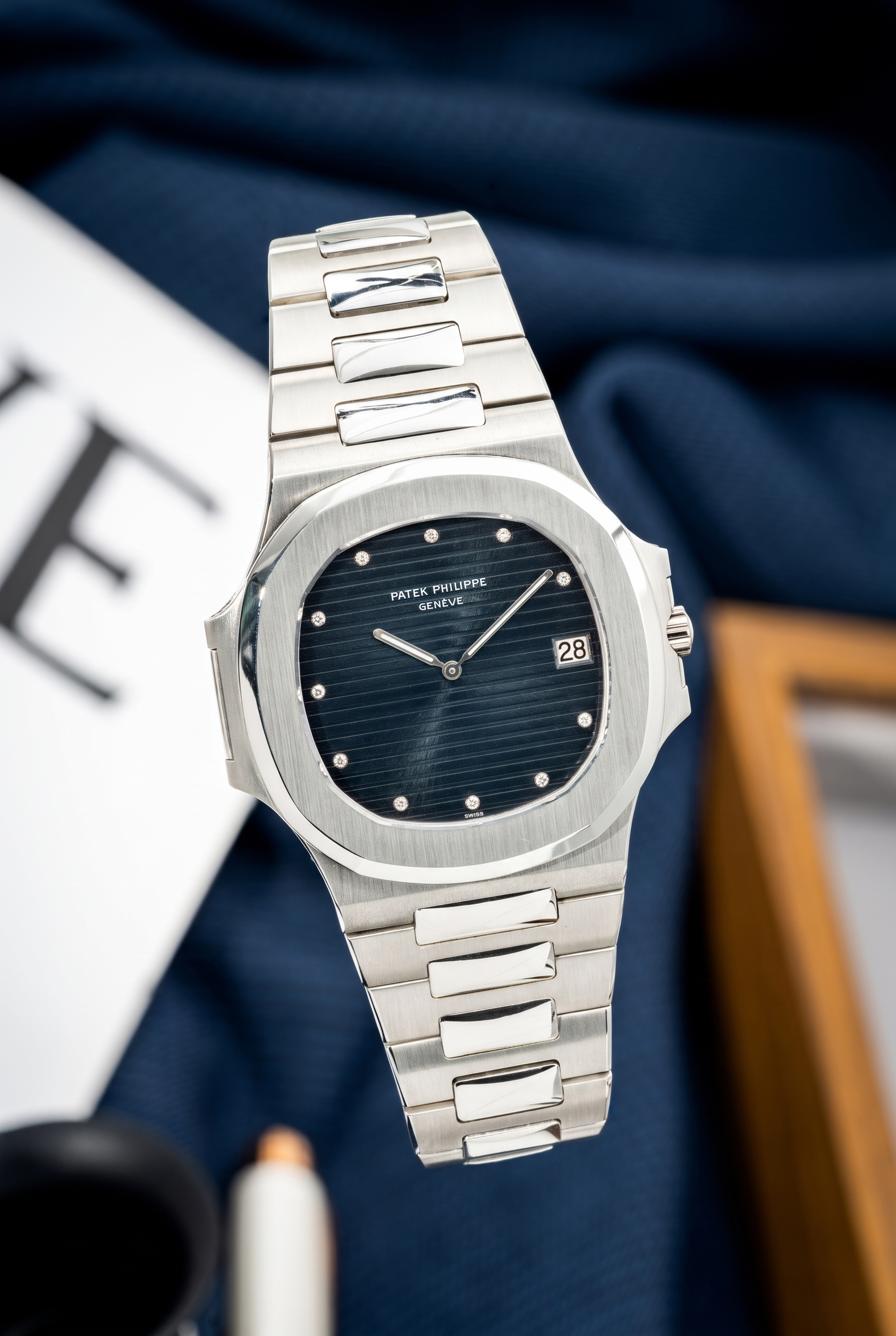
The story of the Patek Philippe Nautilus Ref. 3700/1P, an extraordinarily rare interpretation of Gérald Genta’s most enduring design.
There is a certain irony to the existence of a platinum Nautilus.
When Patek Philippe introduced the Nautilus in 1976, the watch represented a departure from almost everything the manufacture had previously stood for. Here was a luxury wristwatch fashioned from stainless steel, conceived not as an alternative to precious metal, but as something equally desirable, if not more so.
Its price was audacious. Its appearance was unconventional. And its designer, Gérald Genta, had created something that would fundamentally alter the relationship between luxury and material value.
Yet somewhere within the early history of the Nautilus, an altogether different interpretation emerged.
One made not from steel, but platinum.
Today, the platinum Nautilus Ref. 3700 occupies a particularly fascinating corner of Patek Philippe collecting. Three examples have been documented through major public auctions, each offering a different interpretation of the original design.
To understand why these watches are so significant, we must first return to the circumstances that gave rise to the Nautilus itself.
The Watch That Changed the Meaning of Luxury
By the mid-1970s, the Swiss watch industry was entering a period of considerable uncertainty.
Quartz technology was beginning to challenge the dominance of traditional mechanical watchmaking, while established manufactures faced increasing pressure to reconsider what a luxury wristwatch ought to be.
Patek Philippe, long associated with elegant dress watches and sophisticated complications, took an unusually bold direction.
The Nautilus, introduced in 1976 under the reference 3700/1, was designed by Gérald Genta, whose Royal Oak for Audemars Piguet had appeared four years earlier.
The inspiration was maritime.
Drawing upon the shape of a ship’s porthole, Genta conceived a broad, rounded-octagonal bezel, flanked by distinctive lateral projections and joined seamlessly to an integrated bracelet.
The result was unmistakable.
At approximately 42mm across its broadest dimension, the original Nautilus was unusually large by contemporary standards, earning it the nickname Jumbo. Its horizontally embossed dial, slender profile and contrasting brushed and polished surfaces gave the watch a character quite unlike Patek Philippe’s traditional offerings.
Most importantly, it was made in stainless steel.
This was not merely a practical choice. It was the central idea behind the watch.
The Nautilus proposed that design, craftsmanship and mechanical sophistication could establish value independently of the intrinsic worth of the case material.
It was a radical proposition from one of Switzerland’s most traditional watchmakers.
And it worked.
When Steel Became Platinum
The existence of a platinum Nautilus is compelling precisely because it appears to contradict that original philosophy.
If the Nautilus had demonstrated that steel could be a luxury material, what purpose could a platinum version possibly serve?
Perhaps the answer lies in the nature of collecting itself.
The most extraordinary watches are not always those that introduce new complications or revolutionary mechanisms. Sometimes, they are familiar objects interpreted in ways that were never intended for widespread production.
The platinum Nautilus belongs to this category.
Unlike the stainless-steel Ref. 3700, which was produced over many years, platinum examples were never established as a regular catalogue offering.
Instead, the surviving historical record points towards an extremely small number of exceptional creations, likely produced in response to individual commissions.
The precise circumstances surrounding their manufacture remain incompletely documented. What is clear, however, is that the known platinum watches emerged from a period when the original Nautilus was still relatively young.
Their existence reveals an intriguing side of Patek Philippe’s history: a willingness to accommodate extraordinary requests within a design that had only recently challenged the conventions of luxury watchmaking.
The resulting watches retained the essential character of the Nautilus.
They were simply executed in a material that transformed the experience of wearing one.
Three Remarkable Appearances
The historical significance of the platinum Ref. 3700 is inseparable from its scarcity.
For many years, these watches were almost entirely absent from public discussion. Their existence became better understood only as individual examples began appearing at major auctions.
In May 2013, Christie’s Geneva offered a platinum Ref. 3700/1 with diamond hour markers, manufactured in 1981. The watch achieved CHF 783,750, drawing considerable attention to a configuration that few collectors had previously encountered.
Further discoveries followed.
A platinum Ref. 3700/031, manufactured in 1982 and distinguished by its elaborate diamond-set bezel, appeared at Christie’s Geneva in November 2023, achieving CHF 1,618,000.
That same month, Phillips Geneva presented another extraordinary example: a platinum Ref. 3700/1 bearing the signature of historic Swiss retailer Gübelin. It sold for CHF 2,540,500.
These three public appearances provide an unusually revealing picture of early platinum Nautilus production.
Rather than a single standardised platinum model, the documented watches display distinctly different configurations.
One features diamond hour markers. Another combines a diamond-set dial with an elaborate gem-set bezel. The Gübelin example introduces the additional distinction of a historic retailer signature.
Together, they suggest that platinum Nautilus watches occupied a special position within Patek Philippe’s production, where individual requirements could influence the final appearance.
It is important, however, to distinguish between the number of examples documented publicly and the number originally manufactured.
Auction scholarship has raised the possibility that additional platinum cases or completed watches may exist. No definitive factory production total has been publicly established.
For collectors, the significance of these watches lies not in an absolute claim that only three were ever made, but in the extraordinary scarcity of surviving, publicly documented examples.
The Quiet Extravagance of a Diamond Dial
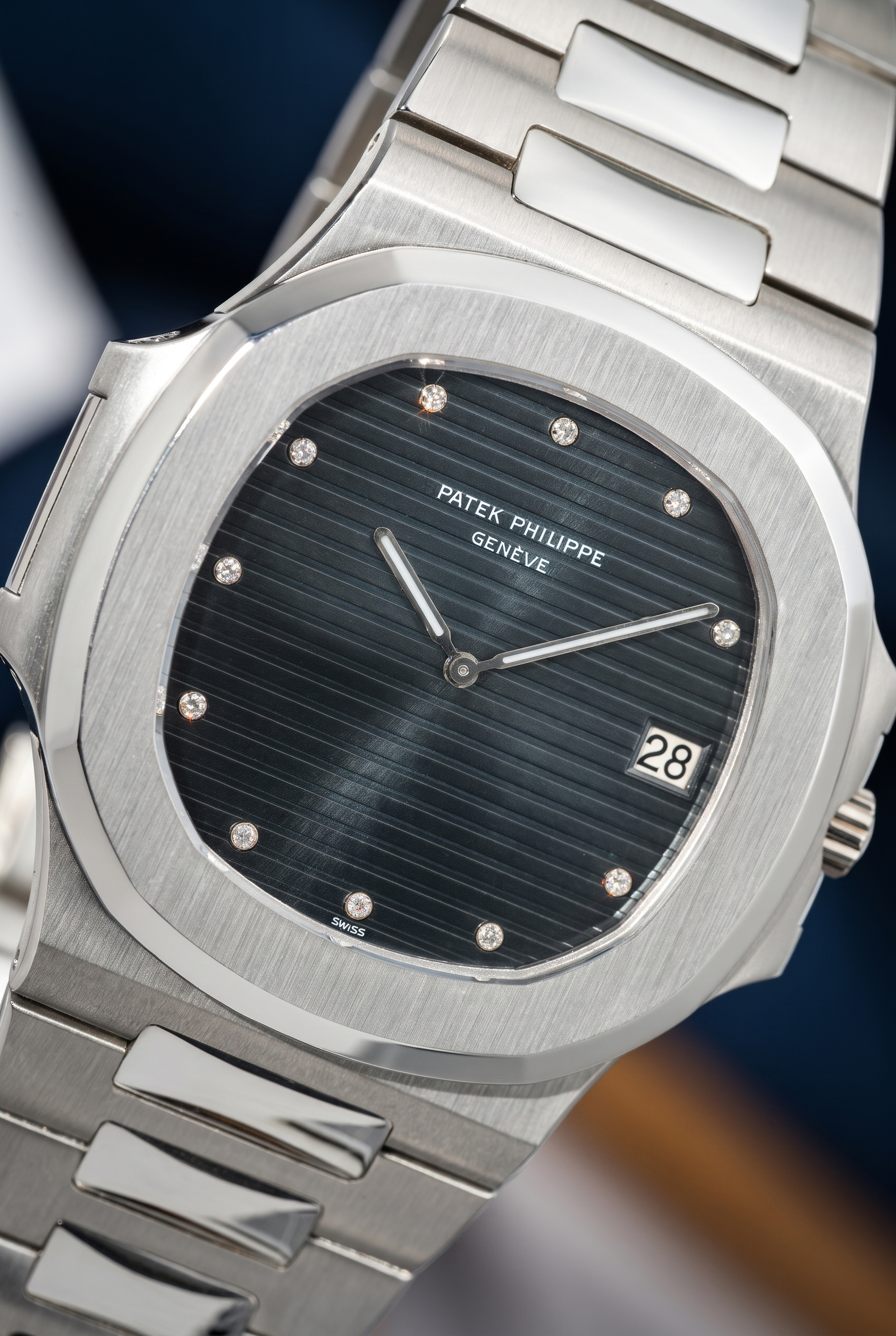
Among the most compelling features of the platinum Ref. 3700/1P is the contrast between its restrained design and the extraordinary nature of its materials.
The dial follows the familiar architecture of the original Nautilus.
Horizontal grooves extend across a dark, graduated surface, creating subtle changes in texture and colour as light moves across the watch.
The broad bezel frames the dial without ornamentation, while the date aperture remains at three o’clock.
Yet the conventional hour markers give way to eleven brilliant-cut diamonds.
It is an unusual combination.
The Nautilus was never intended to be a delicate jewellery watch. Its visual identity was built around strength, geometry and functional simplicity.
The diamonds introduce another dimension without fundamentally altering that character.
Against the dark dial, they appear almost architectural: small points of light arranged within a design otherwise defined by straight lines, broad surfaces and restrained proportions.
This is perhaps what makes the configuration so compelling.
The watch does not attempt to conceal its precious nature, but neither does it abandon the language of the original Nautilus.
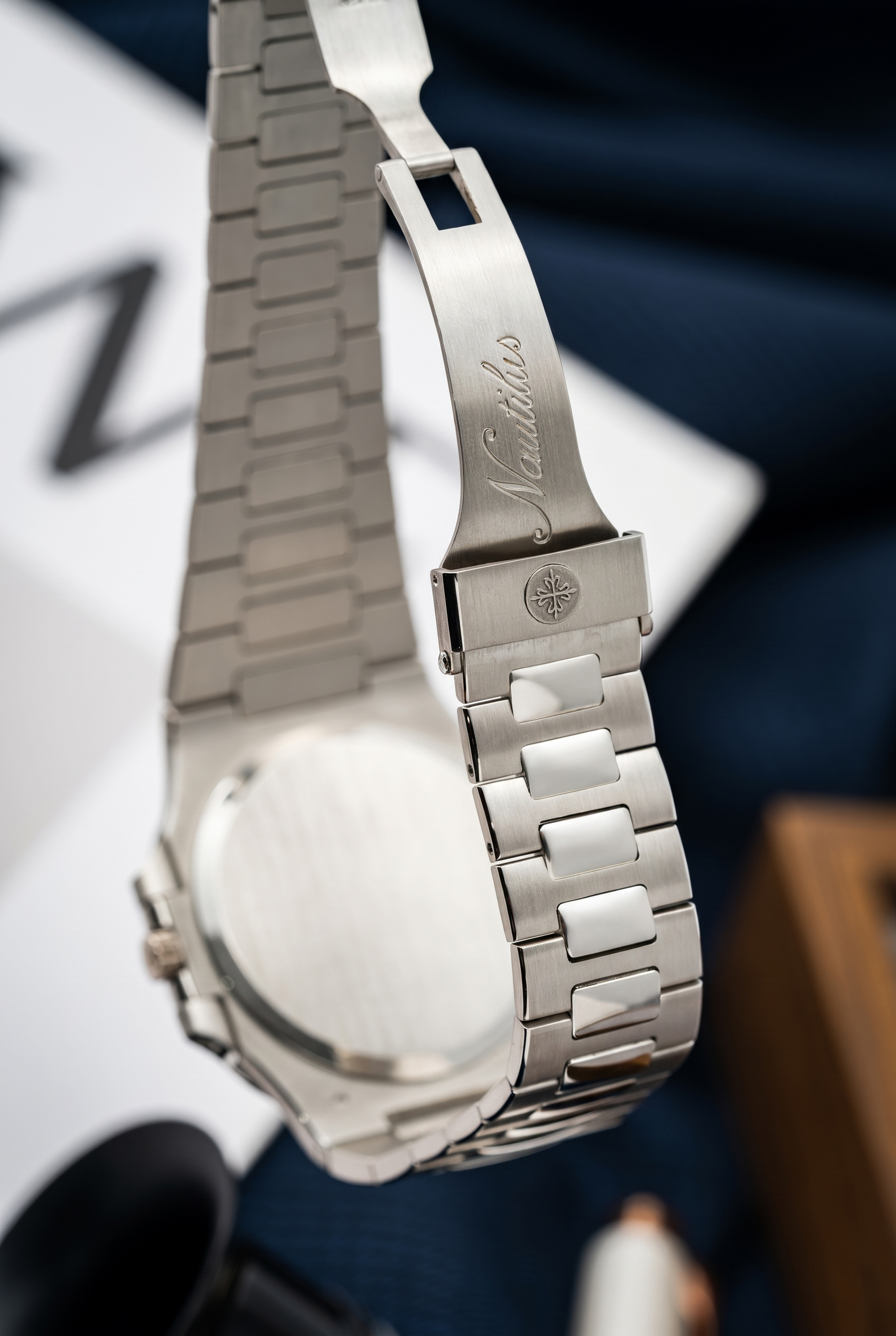
The platinum case and bracelet reinforce the same contradiction.
Visually, platinum can appear remarkably understated. Its colour is close to that of steel, particularly when viewed from a distance.
On the wrist, however, the difference is unmistakable.
Platinum’s density lends the watch a substantial presence, particularly when combined with the integrated bracelet.
The visual impression remains one of elegant simplicity.
The physical experience is entirely different.
An Extraordinary Movement in an Uncomplicated Watch
Beneath the dial lies the Calibre 28-255 C, a movement that deserves attention in its own right.
Derived from the Jaeger-LeCoultre Calibre 920 architecture, this ultra-thin automatic movement was among the most technically sophisticated of its generation.
Its design enabled Patek Philippe to create a relatively slim sports watch without sacrificing automatic winding.
The movement also featured the manufacture’s Gyromax balance and a date mechanism, offering a combination of practicality and refinement well suited to the Nautilus.
Interestingly, the Calibre 920 architecture was shared, in different executions, by several of the most important luxury sports watches of the era.
This connection places the original Nautilus within a broader chapter of Swiss watchmaking history, when leading manufactures were experimenting with new interpretations of the elegant mechanical sports watch.
The platinum Ref. 3700/1P retains this same essential movement architecture.
There is no tourbillon, perpetual calendar or minute repeater.
In conventional terms, it is a comparatively simple automatic wristwatch displaying the hours, minutes and date.
And yet, in the context of Patek Philippe collecting, it is among the most exceptional expressions of the original Nautilus.
Its importance is not measured by the number of complications it contains.
It is measured by the circumstances of its creation.
Beyond Rarity
It is tempting to consider the platinum Nautilus primarily in terms of scarcity.
After all, few watches offer such an extraordinary contrast between an internationally recognised design and such limited public documentation.
Yet rarity alone does not explain its appeal.
The platinum Ref. 3700 represents an unusual moment in the evolution of the luxury sports watch.
It takes a design conceived to challenge the importance of precious metals and returns it to the world of traditional material prestige.
It combines the industrial clarity of Gérald Genta’s original vision with the exceptional craftsmanship associated with Patek Philippe’s most exclusive creations.
And it reminds us that some of the most interesting watches are those that resist easy categorisation.
The platinum Nautilus is neither a conventional sports watch nor a traditional precious-metal dress watch.
It is an object that belongs comfortably to both worlds, while remaining entirely distinct from either.
Nearly half a century after the Nautilus was introduced, that contradiction remains as compelling as ever.
The original Nautilus proved that luxury did not need to be made of gold or platinum. The platinum Nautilus reminds us that the rarest interpretations of an icon can sometimes challenge the very idea that made it famous.
Discover the Patek Philippe Nautilus Ref. 3700/1P at J.PENDULUM
J.PENDULUM specialises in rare Patek Philippe timepieces, grand complications and historically significant watches from the world’s most respected manufactures.
A platinum Nautilus Ref. 3700/1P with diamond hour markers is currently listed in our collection in Singapore, accompanied by a 2026 Patek Philippe Extract from the Archives and Geneva service documentation.
Collectors are invited to explore the watch and enquire about a private viewing at our Far East Plaza boutique.
J.PENDULUM
14 Scotts Road, Far East Plaza
Singapore 228213
View the Patek Philippe Nautilus 3700/1P